What to Do When Your Mind Won't Switch Off at Night
It starts in your body.
Not your mind, your body. The bone-deep tiredness that should, by all rights, pull you under. The aching muscles that have been carrying the weight of the day. The heaviness that settles into you the moment you stop moving.
And yet sleep doesn't come.
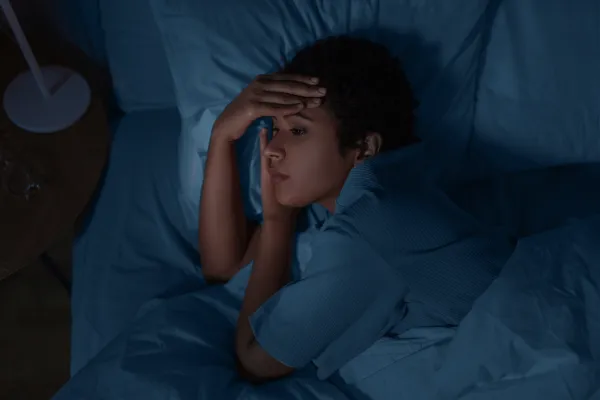
You lie there, exhausted in a way that goes beyond tired, and your body just won't settle. Can't find the position, can't release the tension, can't cross that threshold. And then, because the quiet has finally arrived and there's nothing left to distract it, your mind starts.
It doesn't tend to go somewhere useful.
It doesn't plan tomorrow helpfully or work through something constructive. It goes rummaging through the archive, and it doesn't surface the good stuff. It surfaces the moments you'd rather have forgotten. A choice you made years ago. A relationship that cost your family something. A version of yourself that acted without thinking, that moved too fast, that didn't see what was coming.
And alongside the memory, almost always: shame.
Not the loud, dramatic kind. The quiet, middle-of-the-night kind that sits on your chest and replays itself until you're too exhausted to keep watching. Until eventually, somewhere in the early hours, your body just gives up and pulls you into sleep more out of sheer depletion than anything like rest.
If this is familiar, I need you to know something first: this is not you being dramatic. This is not your mind punishing you. This is what happens when a nervous system that has been braced all day finally gets quiet enough to process, and finds it has a backlog.
Here's something worth understanding about nighttime and the nervous system.
During the day, we are busy. Movement, noise, tasks, conversations, all of it keeps the system occupied. But at night, when the stimulation drops away, the nervous system doesn't automatically shift into rest. If it's been in a state of low-level vigilance all day, scanning, preparing, holding, it often just keeps going. And in the absence of anything present to focus on, it reaches backwards.
This is why the memories that surface at night are often the ones that still carry emotional charge. The unresolved ones. The ones where some part of you is still, quietly, working something out.
It's not random. It's not weakness. It's your system doing what it was built to do, just at completely the wrong time.
The shame piece is its own particular weight.
Because here's the thing about looking back at choices made from a younger, less steady version of yourself, those choices were real. The consequences were real. And yet you are also not that person anymore. You know what you know now because of what you lived through then. The impulsiveness, the partners who weren't right, the moments you acted without thinking, they shaped you into someone who thinks more carefully, loves more deliberately, understands more deeply.
Both things are true. The growth is real. And the shame still comes anyway.
You don't have to resolve that tension to get through the night. You just have to know that the shame visiting you at 2am is not the truth about who you are. It's an old story your nervous system hasn't quite finished filing away yet.
So what actually helps?
Not forcing your mind to stop, that rarely works and usually makes it louder. Not scrolling, not lying there trying to think positive thoughts, not rehearsing reasons why you should feel fine.
What helps is giving your nervous system something gentle to anchor to. A voice. A breath. A reminder that right now, in this moment, you are safe. That the past is not happening to you right now. That you are allowed to rest.
This is exactly what The Nighttime Companion was made for. Not to fix your sleep or silence your mind, but to sit with you in those hours when you feel most alone with yourself. A gentle support kit that gives your nervous system something to come back to, again and again, until the replaying slows and sleep finds you.
You don't have to white-knuckle your way through another night alone.
[Find The Nighttime Companion here.]
Always In Your Corner
Sask xx